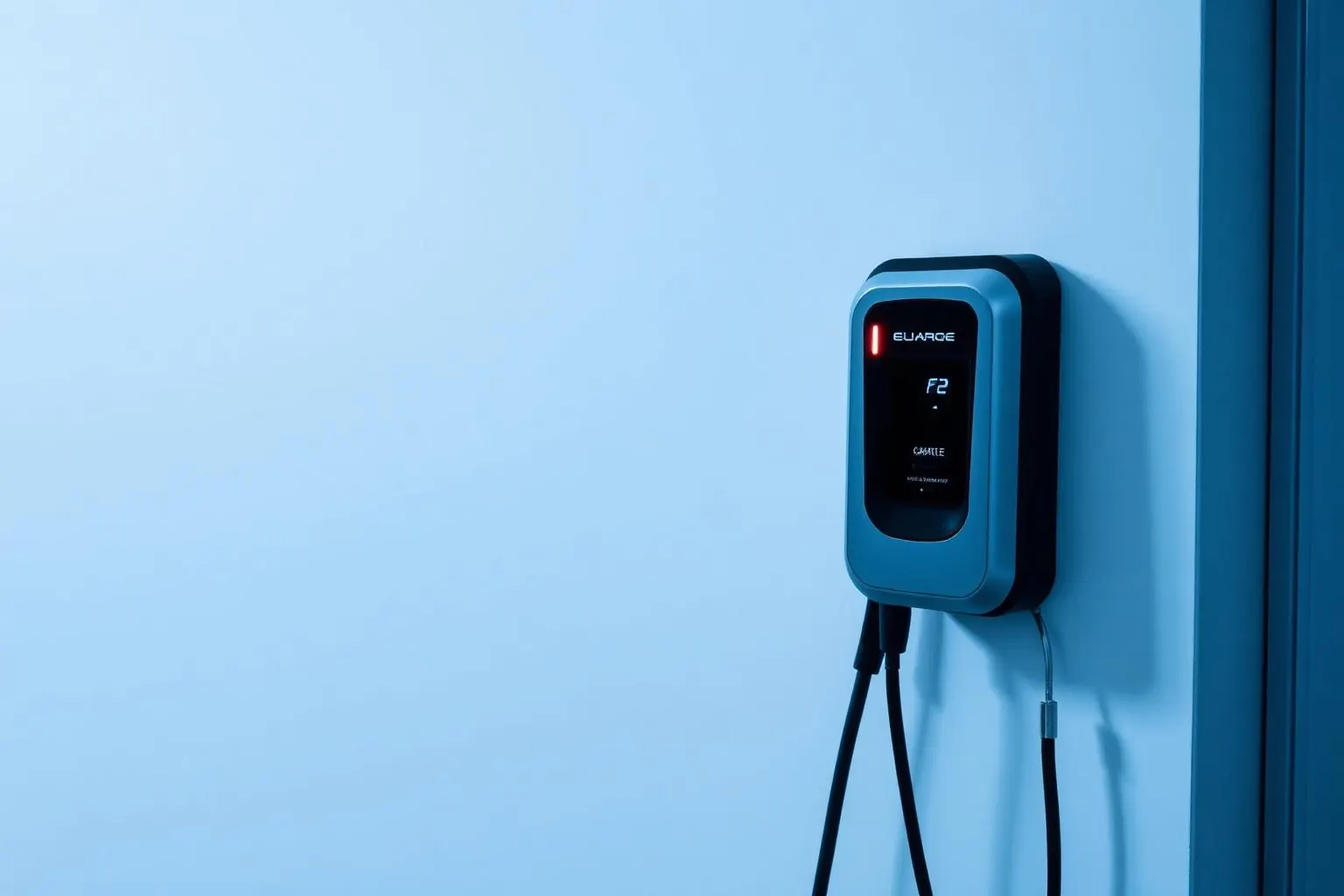
EV Charger Installation in Bellingham, WA
You bought the car. Now you need the charger, and you want it installed by someone who treats it as electrical work, not an accessory bolt-on. Bellingham Electrical installs Level 2 home EV chargers across Bellingham and Whatcom County: load calculation first, the right size circuit, a permit on file, and a state inspection to close it out.
Plenty of companies will hang a charger on your wall. The install is not the hard part. The hard part is confirming your electrical service can carry a 40 to 60 amp continuous load on top of everything else in the house, and doing it in a way that passes inspection. That is the job we quote.
Call or text (360) 218-4499 or book online.
Licensed, bonded, and insured. WA L&I contractor registration CASCACH748MH.
Licensed electrical work, led by Eric Chan, WA electrical administrator AD CHAN*E*743C7.
$129 service call, credited toward the work if you hire us.
On time or it's on us. Miss the window we gave you and the $129 service call is free.
What a proper EV charger installation involves
Here is the work behind the work, in the order we do it.
- 1
Load calculation. Before anything gets wired, we run a load calculation on your home: the size of your service, what your panel already feeds, and how much capacity is genuinely left. A charger is one of the largest continuous loads a house ever takes on, and guessing is how panels end up overloaded.
- 2
Panel capacity check. We open the panel and verify what the label claims: main breaker size, available spaces, condition of the bus and existing breakers. A 200 amp service with room to spare is a straightforward install. A full 100 amp panel is a different conversation, and we will have it with you honestly.
- 3
Circuit sizing. Level 2 chargers run on a dedicated 240 volt circuit, typically 40 to 60 amps depending on the charger's output. Code requires the circuit to be sized above the charger's continuous draw, so a 48 amp charger needs a 60 amp circuit, and a 40 amp charger needs a 50 amp circuit. We size the breaker and wire to the charger you actually have, not a one-size default.
- 4
Mounting and wiring. We run the circuit, mount the charger where it serves your parking spot, and terminate everything to the manufacturer's spec.
- 5
Permit and inspection. We pull the electrical permit and get the install inspected. Inside Bellingham city limits, permits and inspections run through the City of Bellingham Permit Center. In Ferndale, Lynden, Blaine, Birch Bay, and unincorporated Whatcom County, they run through WA Labor and Industries. You get a charger that is documented, not just working.
Who issues that permit depends on the address: the City of Bellingham inside city limits, WA L&I everywhere else in Whatcom County. The full breakdown is in our guide to EV charger permits in Whatcom County.
Hardwired or plug-in? Which charger should you buy?
We are brand-agnostic. We install the charger that fits your car, your panel, and your budget, whether that is a Tesla Wall Connector, a Rivian Wall Charger, a ChargePoint, an Emporia, a Grizzl-E, or the unit your automaker shipped with the vehicle. If you have not bought one yet, tell us your car and how you drive and we will point you at sensible options. We do not mark up a house brand.
The real decision is hardwired versus plug-in:
Hardwired chargers connect directly to the circuit. They allow the highest charging rates (up to 48 amps on a 60 amp circuit), have no plug connection to wear out, and are the cleaner choice outdoors. The Rivian Wall Charger is a typical example: a hardwired NACS unit rated up to 48 amps (11.5 kW), matching the NACS port on 2026 and newer Rivians.
Plug-in chargers connect to a heavy 240 volt receptacle, most commonly a NEMA 14-50. Charging tops out lower (40 amps on a 50 amp circuit), but the charger is easy to replace or take with you when you move. Receptacle installs also require GFCI protection under current code, which is part of why a bargain receptacle quote is sometimes not code-compliant.
Neither answer is wrong. We will tell you which one fits your situation and price both if you want to compare. One thing worth checking before you buy the unit: which EV charger rebates in Washington still exist, because the qualifying models are specified.
Garage or outdoors?
Garage installs are the common case: shorter runs to the panel, weather protection, and simple mounting. We position the charger for your cable to reach the charge port without stretching across the hood.
Outdoor installs are completely doable and we do them regularly. The charger needs to be rated for outdoor use, receptacles need weather-rated in-use covers, and the wiring method changes. Driveway and carport charging works fine when it is built for the Pacific Northwest instead of adapted to it.
Long runs from the panel to a detached garage or the far side of the house are where quotes vary most between homes. That is a wire-length and routing question, and it is exactly why we look before we quote. For the published ranges behind those quotes, see what drives EV charger installation cost in Washington.
What if my panel does not have the capacity?
Sometimes the load calculation comes back tight. That is not a dead end, and it does not automatically mean a new panel. Options we walk through with you:
A lower-amperage charger. A 32 amp charger on a 40 amp circuit still charges most EVs overnight with room to spare. Faster is not always necessary.
A load management device. Some setups can share capacity with another large load instead of adding new capacity.
A panel upgrade or service change. If the panel is genuinely full, obsolete, or already flagged for other reasons, upgrading it fixes the EV problem and every future capacity problem at once. See our electrical panel upgrades page for what that involves and what a service change looks like.
We give you the numbers from your own panel and let you pick. The charger quote and the panel conversation stay separate, and we do not inflate one to sell the other. The code based way to find out whether your panel can handle an EV charger is written up in detail.
Charging an EV and adding a heat pump?
EV chargers rarely arrive alone. If a heat pump, induction range, or other electrification project is on your horizon, the smart move is to plan the panel capacity once instead of discovering the limit one appliance at a time. We call that an electrification-readiness assessment, and it is one of the most useful hours you can buy before any of these projects start. Details on our heat-pump and electrification readiness page.
Rebates and incentives, honestly
The federal tax credit for home EV charger installations expired on June 30, 2026, and we will not pretend otherwise in a sales pitch. Utility and state incentive programs change frequently and some have income or equipment requirements, so we do not quote rebate amounts on this page. Ask us what is current when you call and we will tell you what we know, including when the honest answer is that nothing applies to your install.
Straightforward pricing
The site visit is a flat $129, credited toward the job if you hire us. That visit is where the load calculation and panel check happen, so the quote you get is based on your actual house: your panel, your wire run, your charger.
You see the full installed price before any work starts. No hourly meter, no surprise line items when the drywall is open.
FAQ
Ready to charge at home?
Load calculation, right-sized circuit, permit, and L&I inspection, quoted up front by a licensed Bellingham electrician. Flat $129 site visit, credited toward the job.
Cascade Crest Home Services LLC dba Bellingham Electrical. WA L&I license CASCACH748MH. Bellingham Electrical, 8125 Birch Bay Square St, Unit 205, Blaine, WA 98230, (360) 218-4499