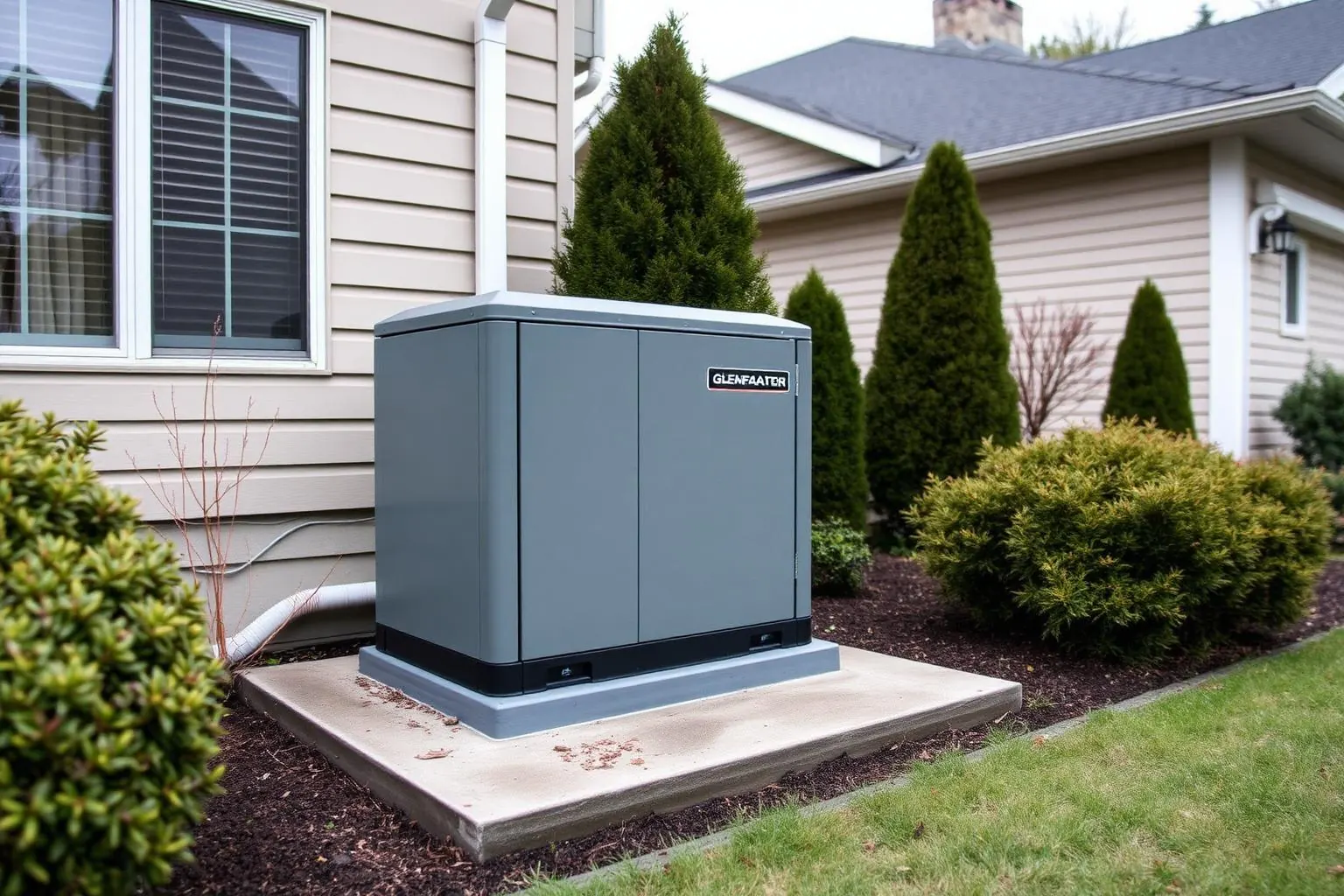
Generator vs Whole-Home Battery in Washington: Running the Actual Numbers
Most comparisons of standby generators and home batteries are written by somebody who sells one of them. This one is written by an electrician who installs both, and it is built out of published numbers you can go check yourself: Puget Sound Energy's filed tariff rates, Generac's own spec sheet, and PSE's own rebate program pages.
The short version is that these two products solve different problems. A battery is a short outage device and an energy bill device. A generator is a long outage device. In Whatcom County, where the outages that actually hurt are multi day windstorm events, that distinction decides the answer more often than price does.
Licensed, bonded, and insured. WA L&I contractor registration CASCACH748MH.
Licensed electrical work, led by Eric Chan, WA electrical administrator AD CHAN*E*743C7.
$129 service call, credited toward the work if you hire us.
On time or it's on us. Miss the window we gave you and the $129 service call is free.
What a generator actually costs to run
Generac's spec sheet for the 22kW air cooled unit (model numbers G007042-10, G007043-10, G007042-11 and G007043-11) publishes fuel consumption directly. The unit is rated 22,000 watts on liquid propane and 19,500 watts on natural gas.
| Fuel | Half load | Full load |
|---|---|---|
| Liquid propane | 92 cubic feet per hour (2.53 gallons per hour) | 142 cubic feet per hour (3.90 gallons per hour) |
| Natural gas | 228 cubic feet per hour | 327 cubic feet per hour |
Those propane figures are the same rate expressed two ways, not three different numbers. Generac's own conversion note on the sheet reads: "For BTU content, multiply ft3/hr x 2500 (LP) or ft3/hr x 1000 (NG)."
For natural gas customers the cost side is knowable. PSE's residential natural gas Schedule 23 carries a $14.00 monthly basic charge and a delivery charge of $0.64407 per therm. The gas commodity itself is billed through Schedule 101 at $0.51888 per therm before taxes, with a Schedule 106 adjustment of negative $0.10710 per therm before taxes, which nets to roughly $0.41178 per therm before taxes.
Add delivery and net commodity and you are in the neighborhood of $1.06 per therm before taxes and before any local surcharges.
A therm is 100,000 BTU, and natural gas at Generac's own conversion runs about 1,000 BTU per cubic foot. So the 22kW unit at half load burns roughly 228 cubic feet per hour, which is about 2.28 therms per hour. At roughly $1.06 per therm that is about $2.42 an hour, or something like $58 a day of continuous running at half load.
For propane there is a gap we are not going to paper over.
What a battery actually costs to run, and what it can pay back
A battery has no fuel cost. What it has instead is a finite amount of stored energy and a utility bill angle a generator does not have.
PSE's residential electric Schedule 7 (39th Revision, issued January 21 2025, with the current step effective since January 29 2026) sets the basic charge at $7.49 per month for single phase service, with energy at $0.141598 per kWh for the first 600 kWh and $0.161015 per kWh above that.
The arbitrage case people get excited about depends on time of use rates, and in PSE territory that case is weaker than the internet thinks. PSE's residential time of use options are capacity capped, not universally available. Schedule 307 is limited to 6,500 accounts. Schedule 327 is limited to 2,500 accounts and PSE's own materials note it may be at capacity. Schedule 327's super off peak rate is $0.075542 per kWh, covering midnight to 7am and 11pm to midnight year round.
If you cannot get onto one of those schedules, and most people cannot, the daily bill savings case for a battery in PSE territory largely evaporates and you are buying it purely as a backup device.
The PSE Flex Batteries program is the real money
This is the part most comparisons miss. PSE runs a demand response program, Flex Batteries, that pays you for letting them call on your battery.
The published structure: $75 per kWh at enrollment, capped at $1,000 per battery, plus $0.50 per kWh for each Flex event the battery participates in, capped at $500 per battery.
On top of that there are two incentive pathways. Pathway A is income and equity qualified and goes up to $10,000 or 100 percent of eligible equipment and installation costs. Pathway B is a reliability pathway worth up to $5,000, and PSE routes inquiries for it to der@pse.com.
Supported hardware at the time we checked: Enphase, FranklinWH, SolarEdge including qualified LG units, and Tesla.
There is no equivalent program that pays you to own a generator. That asymmetry is worth real money and it belongs in the comparison.
The tax credits, including the one that just died
This is where a lot of the advice on the internet is now flatly wrong, because it was written before the rules changed.
The federal 25D residential clean energy credit, which covered home battery storage, is dead for expenditures after December 31 2025. The operative test is when installation was completed, not when you paid. The statutory language treats "an expenditure with respect to an item" as "made when the original installation of the item is completed." If your battery was not installed and finished by the end of 2025, there is no 25D credit for it.
Washington's solar sales tax exemption does still exist. It covers systems of at least 1 kW and no more than 100 kW AC, runs July 1 2019 through December 31 2029, and covers installation charges by a registered and insured installer.
Generators have never had a federal residential energy credit and do not have one now.
The Whatcom County argument
Here is the part that is specific to where you live, and it is the part that usually settles it.
Whatcom County's outage problem is not frequency. It is duration during storm events. PSE's own county level reliability filings show ordinary reliability that is stable and unremarkable, and storm years that are a completely different animal. In a bad year, major event days account for roughly four fifths of your total time without power.
A whole home battery typically carries a house through hours, not days, unless you are running a very disciplined critical loads panel and have solar recharging it. A standby generator on a natural gas line runs as long as the gas keeps flowing.
If your worry is the twenty minute blips, a battery covers those beautifully and you never notice them. If your worry is the November windstorm that puts a tree across a feeder and leaves you dark into a second day, a battery on its own is the wrong tool.
We pulled the actual county reliability numbers apart on a separate page: see our Whatcom County power outage data.
How we would actually decide
Natural gas already at the house, and the concern is multi day storm outages: standby generator, and the running cost math above is knowable.
No gas line, and the concern is short outages plus wanting something out of the investment on normal days: battery, and go after the PSE Flex Batteries enrollment money and Pathway B on the reliability argument.
Both, if the budget is there and the house has critical medical or well pump loads. The battery covers instantly and silently, the generator covers duration, and the battery bridges the transfer.
Neither, if the honest answer is that a portable generator, a properly installed inlet, and a manual transfer switch covers your actual risk for a fraction of the money. We will tell you that, and we will install it correctly. A permanent transfer equipment permit through Washington L&I is $103.20 at the fee schedule effective July 1 2025.
Whichever way that lands, the scope, the sizing and the permit steps are on our generator installation page.
What it takes to install either one legally in Whatcom County
Both a standby generator and a whole home battery are permitted electrical work in Washington. Neither is a homeowner weekend project unless you occupy the property, it is not for sale or rent, and you do the work yourself under your own permit.
Jurisdiction depends on your address. The City of Bellingham is self inspecting and issues and inspects its own electrical permits through its Permit Center at (360) 778-8300. Unincorporated Whatcom County, Ferndale, Lynden and Blaine are all Washington State Department of Labor and Industries jurisdiction.
At the L&I fee schedule effective July 1 2025, a permanent transfer equipment permit is $103.20, a new 0 to 200 amp service is $121.50, and an altered 0 to 200 amp service is $103.20.
Sources
- Generac 22kW air cooled home standby generator specification sheet, models G007042-10, G007043-10, G007042-11, G007043-11.
- Puget Sound Energy Schedule 7, residential electric service, 39th Revision, issued January 21 2025.
- Puget Sound Energy Schedules 307 and 327, residential time of use service.
- Puget Sound Energy Schedule 23 residential natural gas service, Schedule 101 supplemental commodity, Schedule 106 adjustment.
- Puget Sound Energy Flex Batteries program materials.
- Washington State Department of Revenue, renewable energy sales and use tax exemption guidance.
- Internal Revenue Code section 25D and the installation completion rule for expenditure timing.
- Washington State Department of Labor and Industries electrical fee schedule, form F500-133-000, fees effective July 1 2025.
- City of Bellingham electrical permit fee schedule, BSD #192.
All figures accessed and verified July 2026. Rates and program terms change. Verify before you spend money on the strength of them.
Want the version of this math that uses your actual panel, your actual gas service and your actual critical loads? That is what a free install estimate is for.
Call or text (360) 218-4499, or book online. Mon-Fri 7:00 AM to 6:00 PM, Sat 9:00 AM to 1:00 PM (calls and scheduling), closed Sunday.
Bellingham Electrical, 8125 Birch Bay Square St, Unit 205, Blaine, WA 98230, (360) 218-4499. Washington L&I license CASCACH748MH.