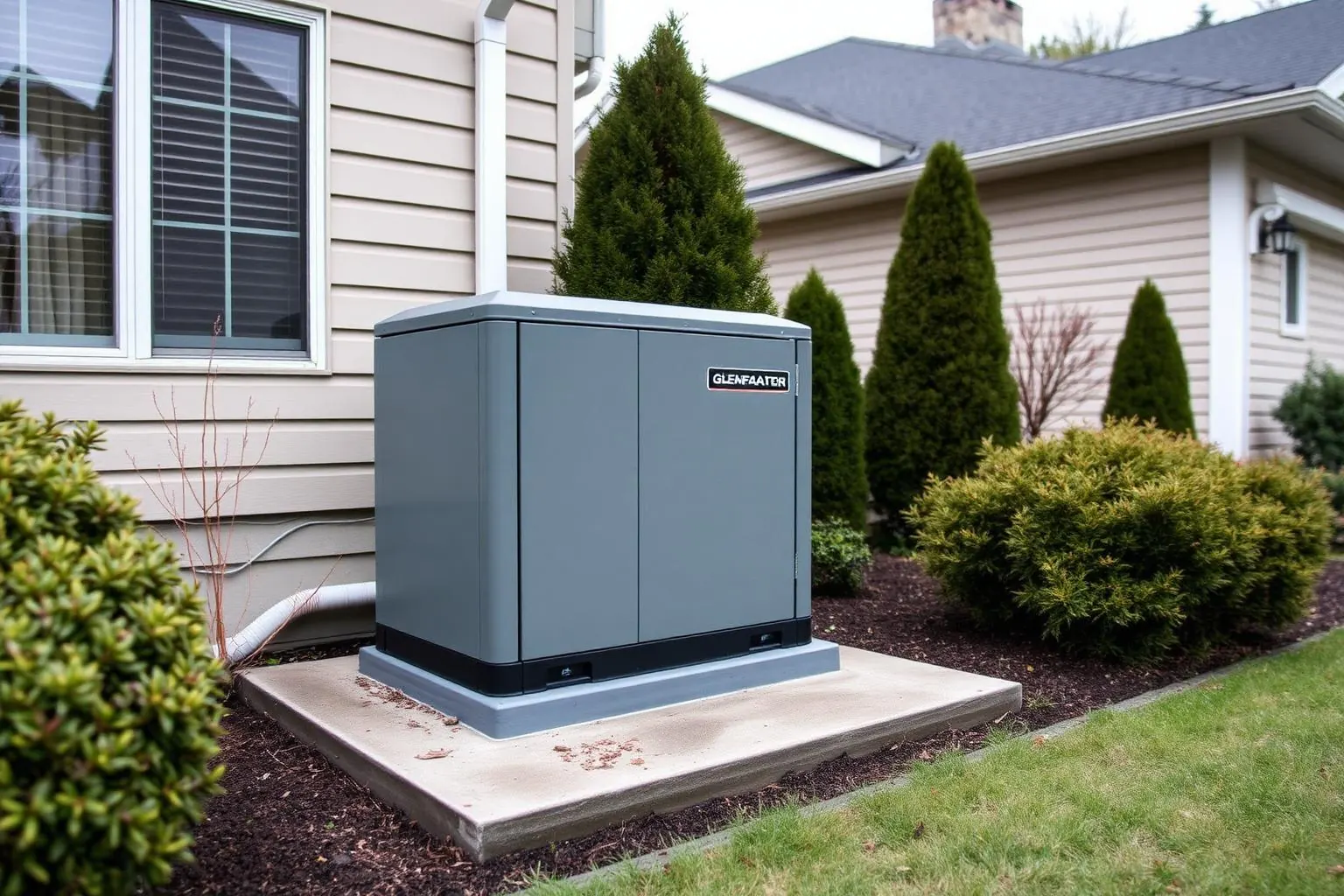
How to Size a Home Generator Without Guessing at Wattage Charts
Search for generator sizing and you will find a hundred charts that tell you a refrigerator is 700 watts and a well pump is 2,000 watts and you should therefore buy a 20kW unit. Those charts are guesses. Your refrigerator is not the refrigerator in the chart, your well pump has a starting surge the chart does not show, and nobody writing the chart has seen your panel.
The 2023 National Electrical Code, which Washington adopts under WAC 296-46B-010, contains a better method. It is the same method used to decide whether an existing service can take a new load, and it works on measurement rather than assumption.
Licensed, bonded, and insured. WA L&I contractor registration CASCACH748MH.
Licensed electrical work, led by Eric Chan, WA electrical administrator AD CHAN*E*743C7.
$129 service call, credited toward the work if you hire us.
On time or it's on us. Miss the window we gave you and the $129 service call is free.
Why we will not publish a wattage chart
We looked for defensible, sourced wattage figures for the appliances that actually matter in a Whatcom County house, particularly well pumps, since a lot of homes out toward Everson, Deming and the county's unincorporated areas are on wells and a well pump is usually the load that decides the generator size.
We could not find figures we would stand behind. Pump wattage varies enormously with depth, horsepower, pump type and starting method, and the numbers floating around online are copied from each other rather than measured.
The method the code actually gives you
NEC 220.87 covers determining existing loads. It gives two acceptable ways to establish what a service is really carrying.
The first is the maximum demand data for a continuous 12 month period. If you can get that, use it.
The second is the fallback most homes need, and it is the one worth knowing about: a minimum 30 day recording of demand, taken with a recording ammeter or power meter, with the resulting maximum demand multiplied by 125 percent.
That 30 day recording is not exotic equipment. A whole home energy monitor does it. An Emporia Vue 3, for example, lists at $279.99 and records circuit level demand continuously. Thirty days of real data from your own panel beats any chart ever written, and it costs less than the difference between two generator sizes.
The practical sequence is: put a monitor on the panel, live your life for a month including at least one cold snap if you can, then size off what the house actually pulled times 1.25.
The two numbers that matter, and they are not the same number
Running watts is what the house draws once everything is settled. Starting watts, sometimes called surge, is the spike when a motor kicks on. Well pumps, heat pump compressors, air conditioners and shop compressors all pull several times their running current for a moment at startup.
A generator sized to running watts and not to surge will nuisance trip the first time the well pump and the heat pump happen to start together on a cold morning. This is the single most common sizing mistake we see, and a monitor with a fast enough sample rate is the only honest way to catch it before you buy.
What a 22kW unit actually gives you
The most common whole home air cooled size is nominally 22kW, and the published ratings are worth reading carefully because they are not one number.
Generac's spec sheet for its 22kW air cooled home standby unit, covering models G007042-10, G007043-10, G007042-11 and G007043-11, rates it at 22,000 watts on liquid propane and 19,500 watts on natural gas.
That is a real derate. If you are on a natural gas line, which most homes inside Bellingham, Ferndale and Lynden city limits are, the unit you bought as a 22kW is a 19.5kW. Size against the natural gas number, not the badge.
Fuel consumption from the same sheet, since it bears on tank sizing for propane customers:
| Fuel | Half load | Full load |
|---|---|---|
| Liquid propane | 92 cubic feet per hour, or 2.53 gallons per hour | 142 cubic feet per hour, or 3.90 gallons per hour |
| Natural gas | 228 cubic feet per hour | 327 cubic feet per hour |
Those propane numbers are the same rate in two units, not two different rates. Generac's own note on the sheet gives the conversion: multiply cubic feet per hour by 2,500 for LP BTU content, or by 1,000 for natural gas.
If you are on propane and you want to ride out a multi day outage, do the arithmetic on your tank before you do it on the generator. At half load the unit eats about 61 gallons a day.
Whole house or critical loads
There is a fork here that has more effect on cost than the generator model does.
A whole house installation with an automatic transfer switch backs up the entire service. It is the simplest thing to live with and the most expensive to buy, and it is what drives you toward the larger air cooled units or into liquid cooled territory.
A critical loads panel backs up a defined subset: the furnace, the well pump, the refrigerator, a few circuits of lighting and outlets, and whatever medical equipment is in the house. It is smaller, cheaper, and requires you to decide in advance what matters. In our experience most Whatcom County homeowners who start out wanting whole house end up happier with a generously sized critical loads panel and the money they saved.
A load management or load shedding device is the middle path. It lets a smaller generator carry a bigger house by dropping non essential loads when demand spikes, so the unit never sees the combination that would have stalled it.
Sizing for the outage you are actually going to have
The Whatcom County reliability picture argues for a specific kind of sizing decision.
Ordinary reliability in Puget Sound Energy territory is stable and unremarkable. The outages that hurt here are storm driven and long. In a bad year, major event days account for roughly four fifths of the total time county customers spend without power. We pulled the filed numbers apart on a separate page: Whatcom County power outage data.
The practical consequence is that you should size for sustained running rather than for a brief bridge. Duration, not peak, is the local problem. That pushes toward natural gas where a gas line exists, toward a larger propane tank where it does not, and away from the temptation to buy the biggest unit and undersize the fuel supply feeding it.
Running the recording and turning it into a sized unit is the first half of a generator installation, and it is the half most people skip.
Permits and who inspects your install
Both the generator and its transfer equipment are permitted electrical work in Washington.
Jurisdiction depends on your address, and this trips people up. The City of Bellingham is self inspecting and runs its own electrical permits through its Permit Center at (360) 778-8300. Unincorporated Whatcom County, Ferndale, Lynden and Blaine are Washington State Department of Labor and Industries jurisdiction.
At the L&I fee schedule effective July 1 2025:
| Permit item | Fee |
|---|---|
| Portable generator, permanent transfer equipment | $103.20 |
| Permanent generator, 0 to 200 amp feeder | $121.50 |
| New service, 0 to 200 amps | $121.50 |
| Altered service, 0 to 200 amps | $103.20 |
| Panel, up to 4 circuits | $74.00 |
| Each additional circuit | $7.70 |
A homeowner may pull their own electrical permit in L&I jurisdiction using form F500-094-000, if they occupy or hold the property, it is not for sale or rent, and they do the work personally. Generator and transfer switch work is not exempt from permit under WAC 296-46B-901, the rule that governs electrical work permits and the exemptions from them.
Sources
- Generac 22kW air cooled home standby generator specification sheet, models G007042-10, G007043-10, G007042-11, G007043-11.
- NFPA 70, National Electrical Code 2023 edition, Article 220.87, determining existing loads. Adopted in Washington under WAC 296-46B-010.
- Washington State Department of Labor and Industries electrical fee schedule, form F500-133-000, fees effective July 1 2025.
- Washington State Department of Labor and Industries homeowner electrical permit application, form F500-094-000.
- WAC 296-46B-901, General, Electrical Work Permits and Fees.
- City of Bellingham electrical permit fee schedule, BSD #192, and City of Bellingham Permit Center.
- Emporia Vue 3 published price, accessed July 2026.
All figures accessed and verified July 2026. Fee schedules and product specifications change. Verify before you commit money.
If you would rather not spend a month reading a monitor, we can do the load assessment as part of a free install estimate and tell you the size the house actually needs.
Call or text (360) 218-4499, or book online. Mon-Fri 7:00 AM to 6:00 PM, Sat 9:00 AM to 1:00 PM (calls and scheduling), closed Sunday.
Bellingham Electrical, 8125 Birch Bay Square St, Unit 205, Blaine, WA 98230, (360) 218-4499. Washington L&I license CASCACH748MH.